
"What's a good lap time at Mid-Ohio?" is the wrong question until you answer three others: which course, which car, and against whom? The club course (2.4 miles, with chicane) and pro course (2.25 miles, without) produce different numbers; a winning TT6 lap and a winning TT1 lap are fifteen seconds apart; and a personal-best HPDE lap has nothing to prove against either. This page gives you real benchmarks — pulled from official NASA Great Lakes results sheets, not forum memory — so you can place yourself honestly. It's part of our Mid-Ohio database.
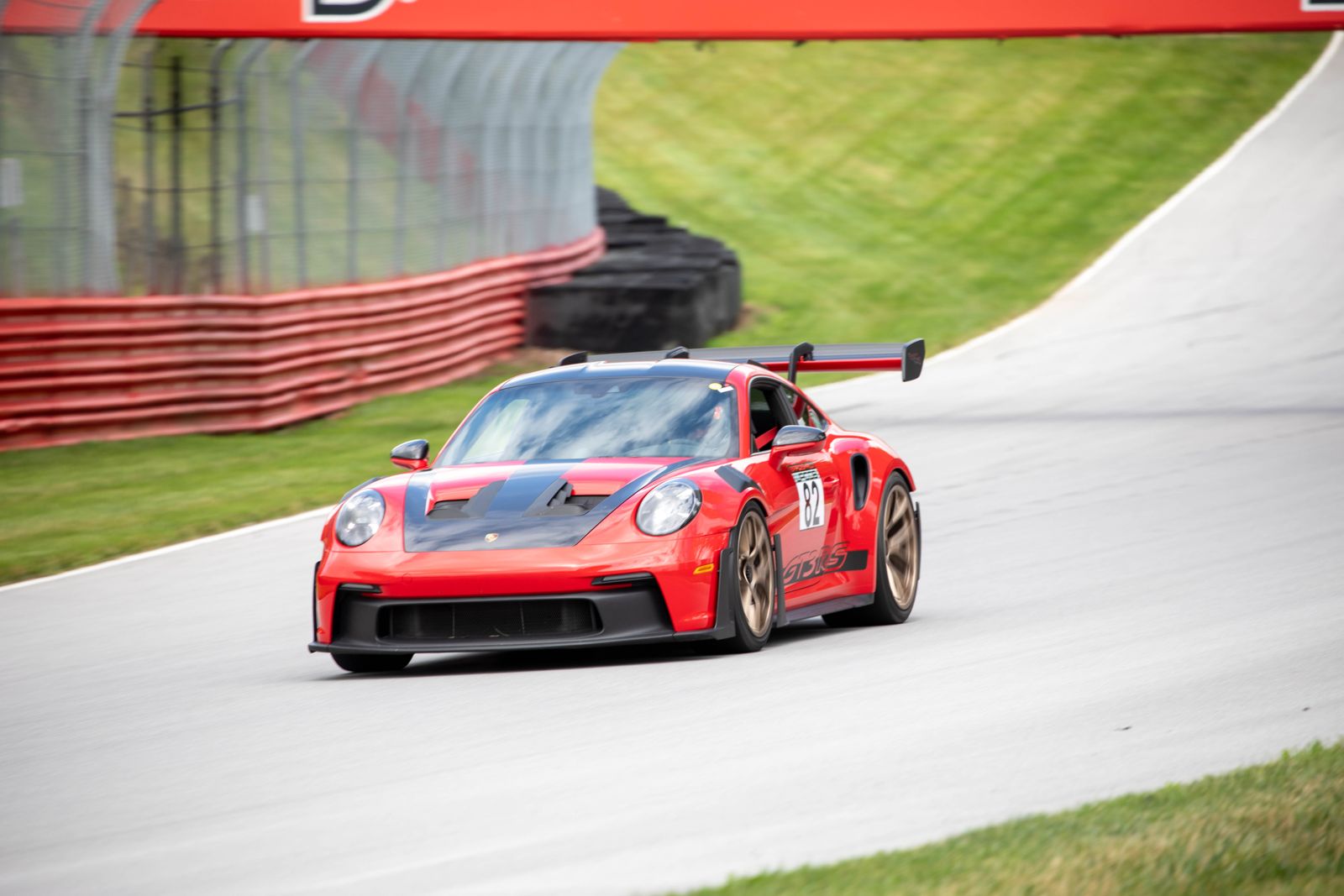
NASA TT winning pace, both courses
The May 2025 NASA Great Lakes weekend is the cleanest comparison you'll find: club course Saturday, pro course Sunday, same drivers, same cars, 24 hours apart. Winning laps by class:
| Class | Club course (Sat) | Pro course (Sun) | Delta |
|---|---|---|---|
| TTU | 1:18.749 | 1:18.333 | +0.4s |
| TTGT | 1:27.242 | 1:25.349 | +1.9s |
| TT1 | 1:30.199 | 1:28.811 | +1.4s |
| TT3 | 1:33.562 | 1:31.050 | +2.5s |
| TT4 | 1:38.552 | 1:38.814 | -0.3s |
| TT5 | 1:38.751 | 1:38.069 | +0.7s |
| TT2 | 1:45.799 | 1:39.885 | +5.9s |
| TT6 | 1:46.413 | 1:43.841 | +2.6s |
Source: official Orbits/MyLaps results, NASA Great Lakes, May 24–25, 2025. August 2025 (pro course both days) ran slightly slower at the front — TT1 wins at 1:30.1 and 1:30.7 — a reminder that conditions move these numbers by a second either way.
Two honest caveats. These are winning laps, not entry requirements — GL TT fields ran one to five cars per class per day in 2025, so the podium math is friendlier than the numbers look. And day-to-day scatter (weather, tires, traffic) is real: treat every number above as the center of a plus-or-minus-one-second band.
Onboard: a 1:30.0 lap of the Pro Course
What the corner-by-corner notes look like at speed. A full lap in a 992.1 GT3 RS — 1:30.0 with a passenger aboard and a pass completed off-line through Turn 1. The driver camera is bottom right so you can watch hands and wheel against the line being driven.
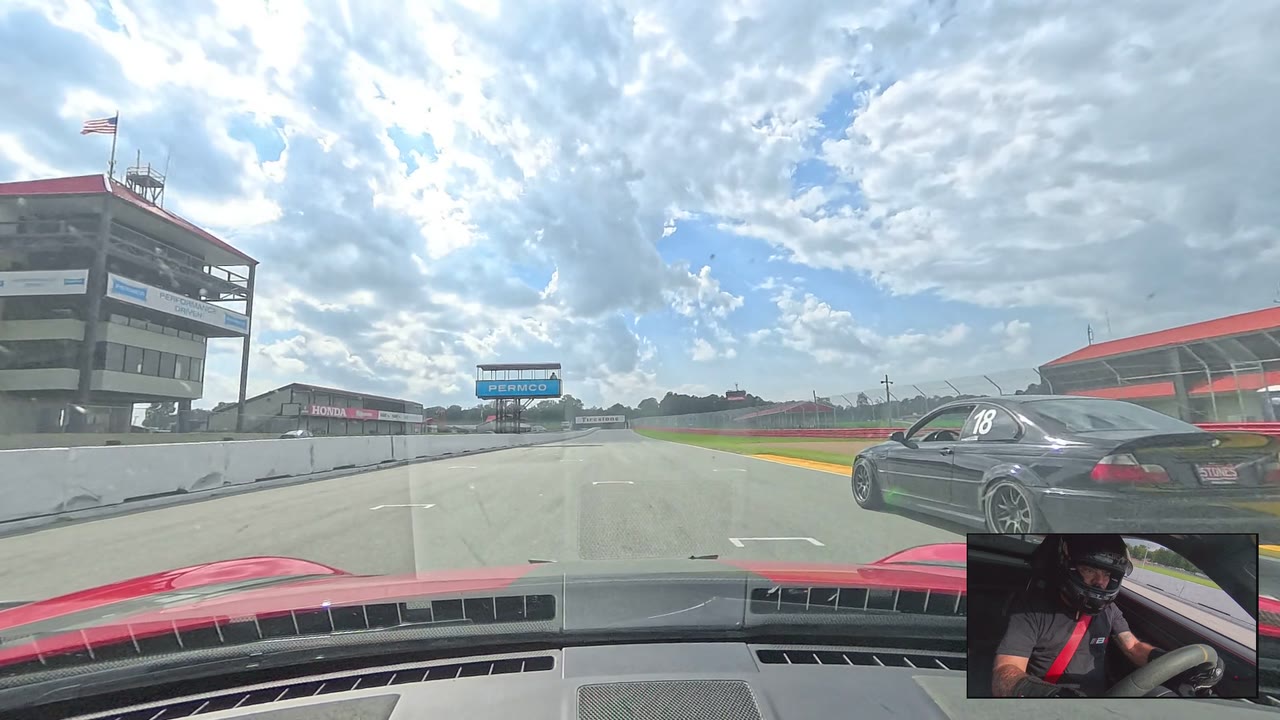
992.1 GT3 RS Weissach · Mid-Ohio Pro Course · Original in-car audio
What the deltas tell you
The chicane and extra 0.15 miles cost most classes 1.5 to 3 seconds. The outliers are informative: TTU barely notices (aero and braking capacity swallow the chicane), while that TT2 delta says more about a single-car class and changing conditions than about geometry. If you're converting a pro-course sim time to a club-course expectation, add about two seconds and you'll be in the neighborhood — then go earn the real number, because the chicane is a braking-discipline test the sim only hints at.
HPDE and street-car benchmarks
For track-day drivers on the club course, in a capable street car on performance tires:
A first-weekend driver getting point-bys sorted typically runs high 1:50s to 2:00s and should not care. An intermediate driver with a season of seat time lands in the mid 1:40s to low 1:50s. A genuinely quick advanced HPDE lap in a well-driven street car — think GT-car, M-car, or Corvette on 200TW tires — is around 1:40, and that's the number that means you've learned the track rather than survived it. Below 1:40 you're running with instructor-pace traffic, and below the mid 1:30s you're at the front of TT3 competition pace and should class your car and get a timing transponder — you're leaving trophies on the table.
Our own reference: the #82 GT3 RS runs TT1-competitive pace, and the classing math behind that is its own story. For what the pros do: IndyCar qualifying on the pro course runs in the low 1:00s-to-mid 1:00s bracket depending on year and rules — a different sport, same pavement, useful mostly for humility.
How to use a benchmark properly
A benchmark is a diagnosis tool, not a goal. If you're three seconds off your class-appropriate number, the time is almost never hiding in one heroic corner — it's distributed across the three exits that matter (Keyhole, Esses, Carousel) at roughly a second each. Chase the exits, resplit the lap, and check again. And remember which course your reference lap came from before you panic: a 1:33 on the club course is quicker than a 1:31 on pro.
Want to know where you'd slot into the 2026 TT field before you commit? Check the Great Lakes schedule — Mid-Ohio hosts three weekends this season — and run your car through the TT Engineer to find your class first.
FAQ
What is a good lap time at Mid-Ohio for a street car? On the club course: around 1:40 is a genuinely quick advanced-HPDE lap on 200TW tires; mid 1:40s is solid intermediate pace; first-weekend drivers should ignore the clock entirely.
How much slower is the club course than the pro course? About 1.5 to 3 seconds for most classes, based on same-driver NASA results from the May 2025 weekend that ran both layouts back to back.
What lap time wins NASA TT1 at Mid-Ohio? In 2025 Great Lakes competition: 1:28.8 on the pro course, 1:30.2 on the club course. August winners ran 1:30-1:30.7 on pro — call it high-1:28s to low-1:30s pace depending on conditions.
What class is your car?
Run your exact build through the TT Engineer — dyno averaging, tire factors, and 2026 class floors computed in about a minute.
Open TT Engineer