
Ask five Mid-Ohio regulars where the lap is won and you'll get one answer with five phrasings: the Keyhole. It's Turn 4–5 on the club course, Turn 2 on the pro course, and the same problem on both — a long, 180-degree right-hander that feels decreasing-radius and feeds the longest full-throttle stretch on the track. Whatever speed you carry out of the Keyhole, you keep for roughly twenty seconds. No other corner at Mid-Ohio pays compound interest like that. This guide is part of our corner-by-corner track guide; here we go deep on one corner.
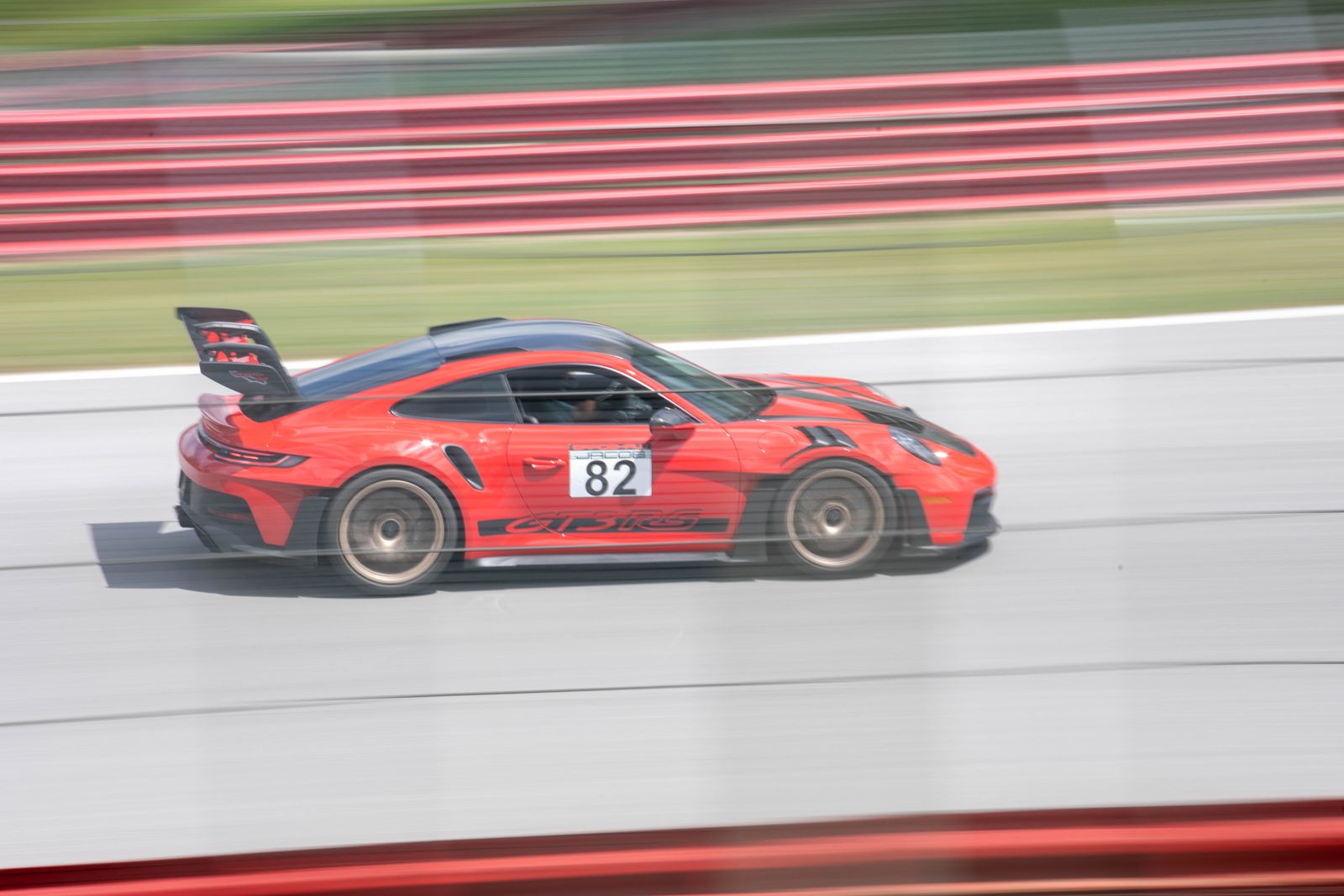
The corner in one paragraph
Approach differs by layout — on the club course you arrive off the chicane with a short run; on the pro course you arrive with more speed off the Turn 1 exit. Either way: brake straight, enter on the left, and resist the pavement's invitation to apex early. The Keyhole reads as one long curb on the inside, and the fast line touches only the last third of it. Hold a wide, patient middle arc, let the corner come back to you, apex late, and open the throttle as the wheel unwinds — with the exit aimed straight down the back straight.
Why patience wins here
The Keyhole punishes entry ambition twice. First, the geometry: it feels decreasing-radius, so speed carried into the first half becomes steering angle in the second half — and steering angle at exit is throttle you can't apply. Second, the consequence zone: an exit compromised by even three or four mph is a deficit you hold the entire length of the back straight. Work it out against a stopwatch and one overcooked entry costs more than a tenth — it costs every car length you'd have gained from the Keyhole exit to the China Beach braking zone.
The inverse is why the corner rewards study. A boring, disciplined entry with a late apex and a straight exit is worth more than any hero move elsewhere on the lap. Slow in, fast out is a cliché everywhere else; at the Keyhole it's an accounting identity.
The line, step by step
Entry. Finish your heavy braking in a straight line on the left side. In competition-pace driving there's a useful trail-braking element — a light trailing pressure to rotate the car through the first phase — but this is a corner where the release must be gentle. Too much brake carried in and the light rear will rotate more than you asked for, right at the start of a very long commitment.
Middle. Stay off the inside curb longer than feels natural. The mid-corner is about maintaining a consistent arc and minimum speed — no additional steering, no throttle stabs. If your hands are busy mid-Keyhole, your entry was wrong.
Apex. Last third of the curb. You should arrive there with the wheel already starting to unwind.
Exit. Progressive throttle as steering opens, track out to the full width, and keep the car straight as it lands on the exit curbing. In the GT3 RS the traction is rarely the limit here in the dry — steering angle is. Straighten the wheel and the corner is over; the throttle takes care of itself.
The classic mistakes
The early apex. Ninety percent of Keyhole errors. Touch the curb early and you've committed to a second turn-in later — the dreaded mid-corner bobble that shows up in data as a double steering peak and a dip in the speed trace exactly where you should be accelerating.
The entry overdraft. Carrying five extra mph in because the entry is wide and inviting. The corner takes the loan and collects on the back straight.
The impatient throttle. Picking up power at mid-corner with steering still loaded. In anything powerful this either pushes you wide (killing the exit line) or asks the rear tires a question they'll answer rudely.
Curb greed. The inside curb is not the line for the first two-thirds of the corner. Driving the curb the whole way looks committed and is slow — it tightens your radius exactly where you want it wide.
Session strategy
The Keyhole is the best corner on the property for deliberate practice because it isolates one skill — exit optimization — and gives you instant feedback via your straightaway speed. Pick a reference at the end of the back straight (your braking marker works) and note your speed there each lap. Change one variable per lap: entry speed down two mph, apex a car-length later, throttle a beat earlier. The trap speed number tells you the truth about the whole corner. It's the same exit-first logic that governs the Carousel — Mid-Ohio's two long corners are cousins, and improvement in one usually shows up in the other.
FAQ
What turn is the Keyhole at Mid-Ohio? Turns 4–5 on the 15-turn club course, Turn 2 on the 13-turn pro course. Same corner, different numbering — locals just say "the Keyhole."
Why is the Keyhole so important for lap time? It feeds the longest full-throttle section of the track, so exit speed compounds for around twenty seconds. It's the highest-leverage exit at Mid-Ohio.
Do you trail brake the Keyhole? Lightly, at pace — a gentle trailing release to help early rotation. But it's an exit corner, not an entry corner: the braking should be effectively done early, and the win comes from the late apex and straight exit.
What class is your car?
Run your exact build through the TT Engineer — dyno averaging, tire factors, and 2026 class floors computed in about a minute.
Open TT Engineer