
A time trial lap at Mid-Ohio is won in a handful of places and lost everywhere you try too hard in the wrong ones. It's a short, busy, elevation-rich circuit where the corners connect tightly — which means mistakes cascade and the priority corners pay enormous dividends. This is the strategy layer on top of our corner-by-corner track guide: not how to drive each corner, but where to spend your effort, how to assemble a fast lap across a session, and the TT-specific tactics that separate a good lap from a wasted one.
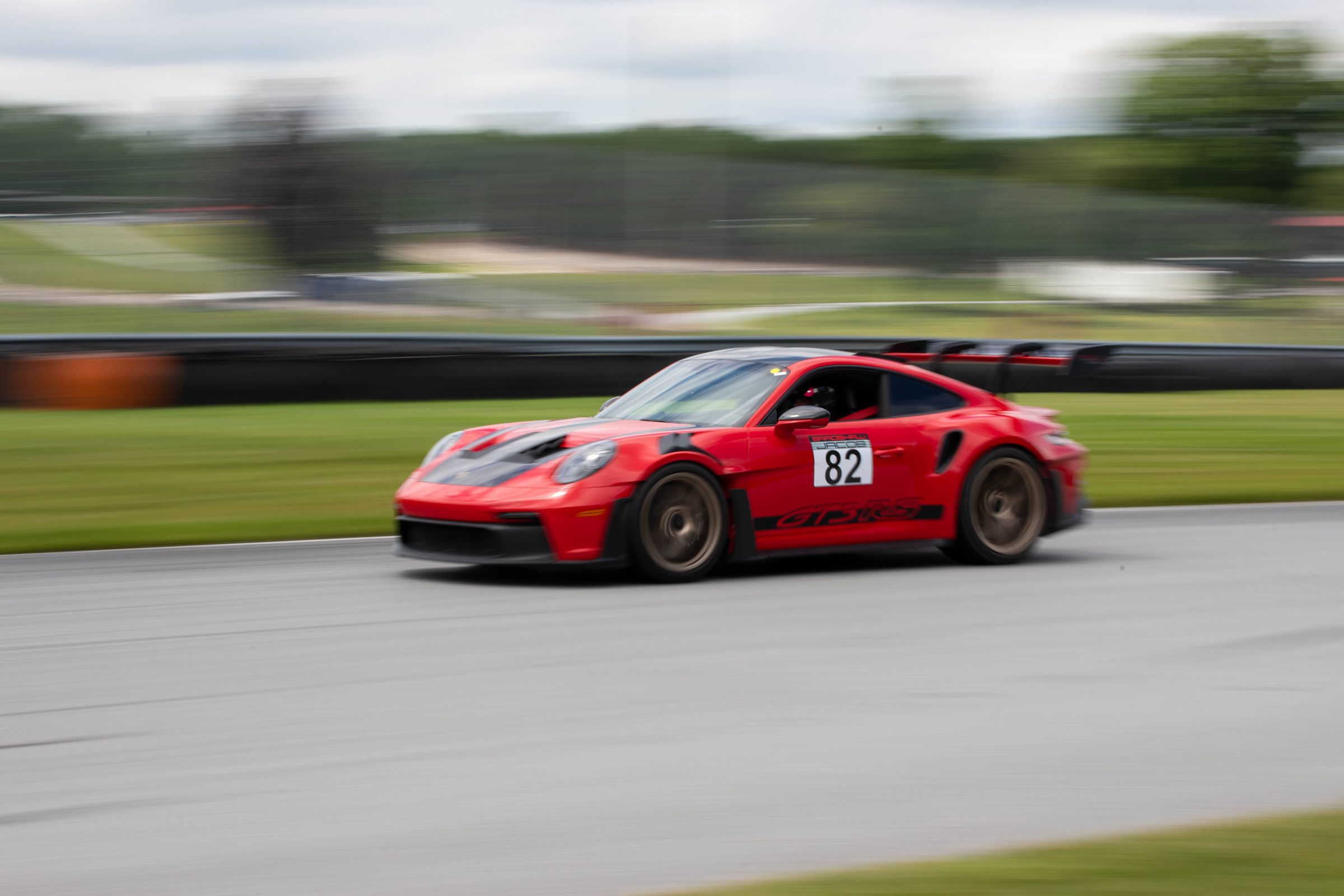
The lap breaks into priority corners
Mid-Ohio's lap time concentrates in the corners that feed its longest full-throttle sections. Rank them and you know where to spend your attention.
The Keyhole is the single most important corner on the lap. It feeds the back straight — the longest sustained acceleration zone on the circuit — so its exit speed compounds over the most distance. A tenth gained at the Keyhole exit shows up as several tenths by the braking zone at the far end. Treat it as the late-apex discipline corner it is: patient entry, wait for the apex, prioritize a clean, early-throttle exit above all else. Everything you're tempted to do to the Keyhole entry to feel fast, don't. Our full Keyhole guide breaks the corner down; for strategy, just know it's priority number one.
The Carousel is priority number two. As the last real corner before the pit straight and the run to Turn 1, its exit sets your speed onto the front straight and into the fastest part of the lap. It's a crested, committed corner where the Carousel guide earns its keep — first-apex patience, a clean exit, and the discipline not to overslow the entry chasing rotation you don't need.
The Esses are the momentum bank. Through the Esses, the game is preserving speed with minimal steering and the smallest possible scrubbing — a flowing, vision-led rhythm rather than a series of distinct corners. Time lost here is quiet and constant; you won't feel it, but the trap will show it. Don't attack the Esses; float through them.
Everything else — the tighter connectors, the slower corners that don't feed long straights — is lower priority. You still drive them well, but you don't sacrifice a priority-corner exit to gain a hundredth in a connector. That's the whole racing-line pecking order applied to one track: win the Keyhole and Carousel exits, flow the Esses, and let the rest serve those.
Building the lap across a session
A time trial lap is assembled, not summoned. TT sessions are short — often 15 to 20 minutes — and the track and your tires are changing the whole time, so having a plan for the session is as important as driving the lap.
Out-lap: build heat, not heroics. Your tires and brakes need temperature before they'll deliver a fast lap, and at Mid-Ohio the surface rewards a properly warmed tire. Use the out-lap to build heat with progressive inputs — some weaving and firm braking — without burning the edge off the tires. Don't send your first flying lap on cold rubber; you'll scare yourself and set a slow benchmark.
Peak window: know when your tires are best. Most track tires give their best one to three laps before they start to go off, and at a short track like Mid-Ohio you can get several timed laps into a session. The strategy is to be at maximum attack when the tires are in their peak window — usually laps two through four of hard running — rather than saving your big effort for the end when the tires are greasy. Front-left is often the limiting tire here given the corner mix; when it starts to slide on entry, your window is closing.
Bank a clean lap early, then improve. Get one tidy, mistake-free lap on the board early as insurance, then use the peak window to chase time. Drivers who wait for the "perfect" lap often never bank one — traffic or a fading tire steals it. A clean lap in hand frees you to push.
Manage the fade. As the tires go off over the session, adapt: smoother inputs, slightly earlier apexes, easing the front-tire load. Your last laps won't be your fastest; don't throw the car at it and risk an off chasing a lap the tires can't deliver anymore.
Traffic: the TT variable that ruins laps
Time trial runs a full field on track at once, and at a short circuit like Mid-Ohio, traffic is the single most common lap-wrecker. Managing it is a skill in itself.
Make space before your hot lap. The best defense is a gap. On the lap before you plan to attack, back off deliberately to open a cushion to the car ahead — a few seconds of clear track is worth more than any single corner. Burning a lap to build a gap is not a wasted lap; it's the setup for your fast one.
Read the mirrors and the passing rules. Know where passing is allowed and expected, and where a faster car will want by. Being passed cleanly costs less time than being surprised. Point people by early and get back to your lap.
Abort intelligently. If you catch traffic in the middle of a good lap, don't force it and don't sulk — settle, rebuild a gap, and go again. A compromised lap you refuse to abandon just burns tire life you needed for a clean one.
TT-specific tactics at Mid-Ohio
A few things specific to running Mid-Ohio against the clock:
Elevation hides grip changes — trust the crests. Mid-Ohio's grip changes with its elevation, and corners like the Carousel entry and the run through Madness load and unload the car over crests. The weight transfer reality is that available grip moves under you; a soft, listening approach over the crests finds time a stiff, committed one throws away.
Course knowledge: know which course you're on. Mid-Ohio runs both the club (short) and pro (long, with the Esses/backstretch chicane) configurations depending on the event. Your priority corners and your reference points shift between them — confirm the configuration and rehearse the right map before you go out.
Use the tool, not just the feel. Where the lap time actually sits for your car — how much your class and power-to-weight let you carry through the priority corners, and what a realistic target lap is — is exactly what our TT Engineer tool is built to help you reason about. Pair it with the Mid-Ohio lap-time benchmarks to set a target that's ambitious and real, then work backward to the corners that will get you there.
The one-paragraph strategy
Warm the tires properly, bank a clean lap early, then attack in the tire's peak window with a gap to clear track ahead. Spend your effort on the Keyhole and Carousel exits, flow the Esses, and let every other corner serve those two. Manage traffic by making space before your hot lap and aborting compromised ones without ego. As the tires fade, get smoother, not braver. Do that, and the lap time at Mid-Ohio — which lives in a small number of places — will come to you.
FAQ
Which corners matter most for lap time at Mid-Ohio? The Keyhole and the Carousel, because they feed the two most important full-throttle sections (the back straight and the front straight), so their exit speed compounds the most. The Esses matter as a momentum section where small, quiet losses add up. Everything else is lower priority.
How many laps does it take to get a fast lap at Mid-Ohio? Usually a warm-up out-lap plus two to four hard laps to reach the tire's peak window. Bank a clean lap early as insurance, then attack while the tires are at their best rather than saving the big effort for the end when they've gone off.
How do you manage traffic in a time trial at Mid-Ohio? Build a gap on the lap before your hot lap by backing off to open clear track, know the passing rules and point faster cars by early, and abort compromised laps to rebuild a gap rather than forcing a ruined lap and wasting tire life.
What tire pressures work for time trial at Mid-Ohio? It depends heavily on the car and tire, but the principle is to reach optimum hot pressure in the tire's peak window; see our Mid-Ohio setup sheet for starting-point pressures by car type and how to dial them in from tire temperatures.
What class is your car?
Run your exact build through the TT Engineer — dyno averaging, tire factors, and 2026 class floors computed in about a minute.
Open TT Engineer